
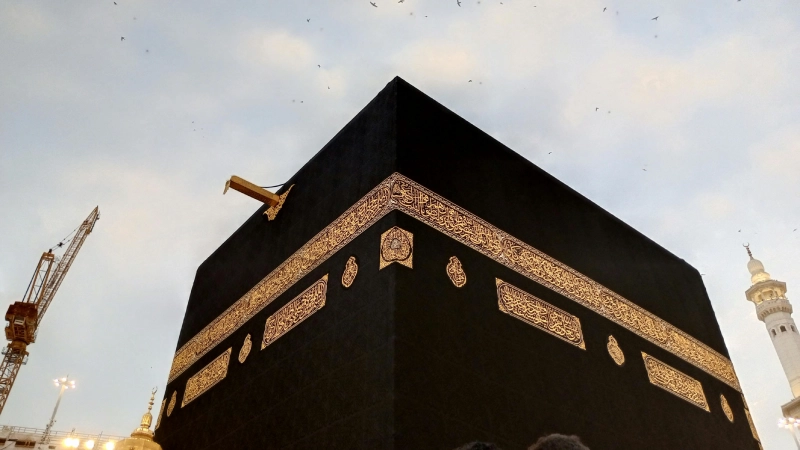
The Black Stone of Mecca: History, Meaning, and Importance in Islam
The Black Stone of Mecca, known in Arabic as Hajar al-Aswad, is one of the most recognized sacred objects in Islam. It is set into the eastern corner of the Kaaba and marks the starting and ending point of tawaf during Hajj and Umrah. For Muslims, its importance is spiritual, not magical: it is honored because the Prophet Muhammad ﷺ honored it.
Introduction to the Black Stone of Mecca
The Black Stone is attached to the Kaaba in Masjid al-Haram in Makkah. Pilgrims begin each circuit of tawaf from its direction, and if they cannot reach it, they point toward it instead. Kissing or touching it is Sunnah when possible, but it is not obligatory and should never be attempted by harming others. (Islam-QA)
The True Story of the Black Stone
Islamic tradition teaches that the Black Stone was sent down from Paradise. A hadith reports that it was originally whiter than milk, then became black because of the sins of the children of Adam. Another narration states that it will come on the Day of Judgment and testify for those who touched it with truth and sincerity. (Islam-QA)
A famous event from the Prophet’s life is connected to the Black Stone. When the Quraysh rebuilt the Kaaba before prophethood, they disagreed over who should place the Stone back in position. Muhammad ﷺ resolved the dispute by having the tribal leaders lift it together on a cloth, then he placed it himself. This incident is remembered as a sign of wisdom and unity.
Is the Black Stone from Heaven?
In Islamic belief, yes, it is traditionally understood to be from Paradise, based on the hadith literature. At the same time, scholars note that this is accepted as part of Islamic tradition and reverence, not something established through modern scientific testing. (Islam-QA)
The History of the Kaaba and the Black Stone
The Black Stone has passed through major historical events. One of the most famous occurred in 930 CE, when the Qarmatians took it from Makkah. Britannica states that it was held away from the Kaaba for about 20 years, while other historical accounts place the return around 952 CE, which is roughly 23 years later. The safest summary is that it was removed in 930 and returned more than two decades later.
The Kaaba has been rebuilt several times throughout history due to damage from floods, conflict, and age. Britannica notes that many Muslims believe Ibrahim and Ismail rebuilt the Kaaba on earlier foundations, and some Muslim traditions trace its earliest origins to Adam. However, this point is best described as a traditional belief rather than a directly verified historical fact.
What Is the Black Stone Made Of?
Its exact composition is not conclusively known. Because access for scientific analysis is extremely limited, claims that it is definitely a meteorite or definitely basalt remain speculative. What can be said with confidence is that the visible Black Stone today consists of several fragments held together within a silver frame.
Rituals and Symbolism of the Black Stone
The Black Stone’s practical ritual role is clear: it marks the point from which tawaf begins and ends. Spiritually, it symbolizes obedience to Allah and following the Sunnah, not an object believed to bring harm or benefit in and of itself. This meaning is beautifully captured in the well-known statement of Umar ibn al-Khattab رضي الله عنه, who said that he knew it was only a stone and that he kissed it only because he saw the Messenger of Allah ﷺ kiss it. (Islam-QA)
This is why Muslims respect the Black Stone but do not worship it. Its importance lies in faith, remembrance, and imitation of the Prophet ﷺ. (Islam-QA)
FAQs About the Black Stone of Mecca
Where is the Black Stone located?
It is located in the eastern corner of the Kaaba, where tawaf begins and ends.
Is kissing the Black Stone mandatory?
No. Kissing or touching it is Sunnah if easily possible. If not, pilgrims may gesture toward it.
Is the Black Stone mentioned in the Quran?
The Black Stone itself is not explicitly named in the Quran, although the Quran repeatedly honors the Kaaba and the sacred rites connected to it.
Was the Black Stone stolen?
Yes. It was taken by the Qarmatians in 930 CE and returned more than two decades later.
Is it a meteorite?
That remains unproven. Some writers have speculated about that, but there is no conclusive scientific identification.
Conclusion
The Black Stone of Mecca remains one of the most meaningful symbols in Islamic sacred history. It is honored because of its connection to the Kaaba, the Prophets, and the Sunnah of Muhammad ﷺ. Its exact material nature may remain uncertain, but its religious meaning for Muslims is clear: it is a sign of devotion, continuity, and obedience in one of the holiest places on earth.