
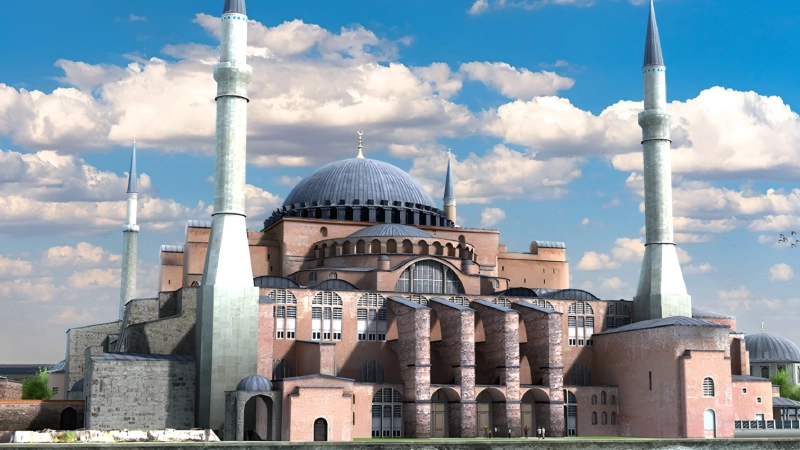
Hagia Sophia: History, Architecture and Religious Significance
Hagia Sophia in Istanbul is one of the most famous religious monuments in the world. Its story stretches across nearly fifteen centuries, and its walls reflect the layered history of empire, faith, art, and architecture. Originally built as a cathedral in 537 CE under Byzantine Emperor Justinian I, it later became a mosque after the Ottoman conquest of Constantinople in 1453, then a museum in 1935, and again a mosque in 2020. It remains part of UNESCO’s Historic Areas of Istanbul World Heritage property. (UNESCO)
For Muslims, Christians, historians, and travelers alike, Hagia Sophia is not just a building. It is a living symbol of how religion, politics, and culture have shaped one of the world’s great civilizations. That is why it continues to attract millions of visitors every year.
The History of Hagia Sophia
To understand Hagia Sophia, we must begin with its remarkable past. The present structure was completed in 537 CE and served as the great cathedral of Constantinople for centuries. It was one of the most important centers of Eastern Orthodox Christianity and remained the world’s largest cathedral for nearly a thousand years. (Wikipedia)
In 1453, after the Ottoman conquest of Constantinople, Sultan Mehmed II converted Hagia Sophia into a mosque. Minarets, a mihrab, and other Islamic features were gradually added, while many Christian mosaics remained part of the structure’s visual history. (Wikipedia)
In 1935, under the Republic of Turkey, Hagia Sophia was turned into a museum. This remained its status until 2020, when Turkey redesignated it as a mosque. It now functions as a mosque while continuing to be a major historic and cultural site visited by people from around the world. (Wikipedia)
Architectural Marvel of Hagia Sophia
One of the main reasons Hagia Sophia fascinates visitors is its extraordinary architecture. Its massive central dome, measuring over 31 meters in diameter, was a stunning engineering achievement for its time and helped change the history of architecture. (Wikipedia)
The interior combines grandeur with spiritual depth. Visitors see soaring arches, large marble pillars, expansive open space, and a powerful balance between structure and light. What makes Hagia Sophia especially unique is the coexistence of Christian mosaics and Islamic calligraphy within the same building. Images associated with Byzantine Christianity remain visible in parts of the interior, while large medallions and Ottoman additions reflect its later Islamic identity. (Wikipedia)
This blend is not accidental. It is the result of centuries of transformation, preservation, and reinterpretation. Few buildings in the world show such a visible overlap of civilizations in a single sacred space.
Religious Significance of Hagia Sophia
Hagia Sophia carries deep religious meaning in both Christian and Islamic history. For nearly a thousand years, it was at the center of Eastern Orthodox Christian life and served as the seat of the Ecumenical Patriarch of Constantinople. (Wikipedia)
After 1453, it became an important imperial mosque of the Ottoman world. The addition of the mihrab, minbar, and minarets transformed it into a major symbol of Islamic rule in Istanbul. Today, as a mosque once again, it continues to serve as a place of worship while preserving visible traces of its earlier Christian past. (Wikipedia)
This layered religious identity is one of the reasons Hagia Sophia remains so significant. It is a place where history did not erase the past completely, but instead left visible marks from multiple eras.
Visiting Hagia Sophia Today
Hagia Sophia remains one of Istanbul’s most visited landmarks. As an active mosque, visitors are generally welcome outside prayer times, but modest dress and respectful behavior are expected. Some visitor guides report that non-worshipper access is limited during prayer hours and especially around Friday noon prayer. (Hagia Sophia Tickets)
It is located in Istanbul’s historic Sultanahmet district, close to other major attractions such as the Blue Mosque and Topkapi Palace. This makes it easy to include in a broader historical and religious tour of the city.
Because rules and access arrangements can change, visitors should always confirm current entry conditions before going. Some recent visitor information sources indicate daily visitor hours around 9:00 to 19:30, with restrictions during prayer times. (Hagia Sophia Tickets)
Why Hagia Sophia Still Matters
Hagia Sophia matters because it stands at the intersection of faith, history, and human creativity. It shows how one building can carry the memory of different empires, different communities, and different centuries without losing its power to inspire.
For some, it is a masterpiece of Byzantine architecture. For others, it is a symbol of Ottoman Islamic heritage. For many visitors, it is both. That rare combination is what makes Hagia Sophia more than a tourist attraction. It is one of the world’s most meaningful sacred monuments.
Zamzam Travels BD
If you are interested in visiting historic Islamic landmarks beyond Makkah and Madinah, places like Hagia Sophia can add a valuable cultural and spiritual dimension to your travel experience. For travelers who want well-organized religious and heritage journeys, Zamzam Travels BD can help with planning, guidance, and travel support. To learn more about available services and travel options, visit https://zamzamtravelsbd.com/
Final Thoughts
Hagia Sophia is one of the most extraordinary buildings in the world because it carries the story of many ages within one structure. It has been a cathedral, a mosque, a museum, and a mosque again. Through all these changes, it has remained a place of awe, reflection, and historical importance. (Wikipedia)
For anyone interested in religious history, architecture, or the shared heritage of civilizations, Hagia Sophia remains a must-know landmark. Its beauty is undeniable, but its deeper power lies in the history it continues to hold.