
Top 10 Mistakes During Hajj and Umrah You Should Avoid
Hajj and Umrah are among the most sacred acts of worship in Islam. They are journeys of humility, obedience, patience, and love for Allah. Yet many sincere pilgrims make avoidable mistakes because of weak information, cultural habits, or practices that are widely repeated without clear proof.
That is why proper knowledge before travel is so important. When a pilgrim understands the Sunnah and avoids common errors, the journey becomes calmer, safer, and more spiritually rewarding. This guide highlights some of the most common mistakes during Hajj and Umrah and explains the correct approach in a simple, clear, and practical way.
1) Thinking Every Dua at the First Sight of the Kaaba Is Guaranteed to Be Accepted
Many people say that the very first dua made upon seeing the Kaaba is always accepted. Seeing the Kaaba is indeed an emotional and blessed moment, but scholars note that there is no sound evidence establishing a special guaranteed acceptance rule for that exact moment. (Islam-QA)
What to Do Instead
When you first see the Kaaba, fill your heart with humility, gratitude, and hope. Make sincere dua, remember Allah often, and ask for forgiveness, guidance, and acceptance. That is a beautiful and recommended response, even though no specific guaranteed formula is established. (Islamweb)
2) Stopping in the Middle of Tawaf to “Kiss” the Black Stone from Far Away
Kissing the Black Stone is a Sunnah for the person who can do so without harming others. But many pilgrims stop suddenly, create congestion, or make gestures that interrupt tawaf and inconvenience the crowd. The correct Sunnah, when one cannot reach it easily, is to point toward it and say “Allahu Akbar,” then continue moving. (Islam-QA)
Correct Practice
Do not push, stop sharply, or create difficulty for other pilgrims. If access is difficult, simply point toward the Black Stone and continue your tawaf calmly.
3) Reciting Duas Loudly in Groups During Tawaf
In some groups, pilgrims repeat duas loudly behind a leader during tawaf. This often disturbs others and turns a deeply personal act of worship into a noisy group routine. Scholars mention that there is no fixed dhikr required for tawaf, and a person may make dua, remember Allah, or recite Quran quietly. (Islam-QA)
Better Way
Make your own dua softly and sincerely. Ask Allah in your own language if needed. Tawaf is a time for presence of heart, not for shouting over others.
4) Assigning a Different Fixed Dua to Every Round of Tawaf
A very common mistake is thinking that each of the seven rounds of tawaf has its own special prescribed dua. Scholars have clearly stated that there is no authentic evidence for assigning a separate fixed dua to every circuit. (Islam-QA)
The well-known supplication between the Yemeni Corner and the Black Stone is:
Rabbana atina fid-dunya hasanah wa fil-akhirati hasanah wa qina adhaban-nar.
Sunnah-Based Advice
You may make any beneficial dua during tawaf. Keep your heart focused. There is no need to carry a booklet that forces one fixed dua for every round. (IslamQA)
5) Thinking the Jamarat Are Actual Devils
Some pilgrims become overly emotional during stoning and behave as if the pillars themselves are devils. This misunderstanding can lead to dangerous behavior such as throwing shoes, large stones, or acting aggressively. Scholars explain that the ritual is an act of worship and a symbol of obedience to Allah, not an attack on a literal devil standing in front of you. (Islam-QA)
Correct Understanding
The purpose of stoning the Jamarat is to follow the command of Allah and remember the rejection of Shaytan. It should be done with calmness, dignity, and obedience.
6) Cutting Only a Few Strands of Hair After Sa'i
After completing Umrah, some men cut only one or two small strands and think they have exited ihram properly. Scholars explain that this is not the correct way. The shortening should clearly affect the hair, and many scholars state that trimming should involve the hair of the whole head, while shaving is even better for men. (Islam-QA)
Correct Method
For men, shaving the head is best, and trimming evenly from all around the head is acceptable. For women, a small fingertip-length cut from the end of the hair is sufficient.
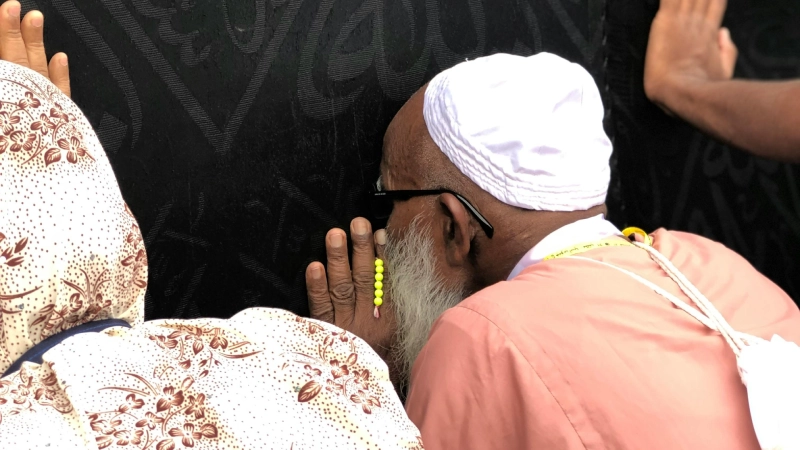
7) Touching or Wiping the Kaaba for Blessings
Many pilgrims try to touch the walls of the Kaaba, wipe the cloth, or touch Maqam Ibrahim for barakah. But the Sunnah does not support touching every part of the Kaaba for blessings. Authentic guidance indicates that the Prophet ﷺ touched only the Black Stone and the Yemeni Corner. (Islam-QA)
What Brings Real Blessing
True barakah comes from following the Sunnah, not from inventing emotional actions. Respect the sacred place, but do not turn unproven practices into worship.
8) Thinking 40 Prayers in Madinah Are Mandatory
Some pilgrims believe that completing exactly 40 prayers in Masjid an-Nabawi is compulsory. Scholars note that the hadith often quoted about the special virtue of forty prayers is weak. That means it should not be treated as an obligation or a condition of a complete visit. (Islam-QA)
At the same time, praying in Masjid an-Nabawi is a great blessing, and some scholars still mention the forty-prayer practice only as encouragement, not as something mandatory. (IslamQA)
Balanced Understanding
Try to pray as much as you can in the Prophet’s Mosque, but do not think your visit is incomplete if you do not reach forty prayers.
9) Wearing Ihram Improperly
Improper ihram is another common mistake. Men sometimes let the ihram slip in a way that exposes what should remain covered. Women in ihram sometimes think they must wear a stitched niqab or gloves, even though many scholars state that a woman in ihram should not wear a niqab or gloves specifically made for that purpose. She may, however, lower a loose covering over her face when needed in front of non-mahram men. (Islam-QA)
Practical Advice
Men should secure the ihram properly and maintain modest coverage at all times. Women should learn the rulings of ihram before travel so they can dress correctly without confusion.
10) Treating Tawaf as an Act That Can Simply Be Done by Proxy
Another mistake is assuming that a separate tawaf can always be performed on behalf of someone else in the same way people discuss Hajj or Umrah by proxy. Many scholars state that tawaf itself is not ordinarily delegated as a separate standalone act unless it is part of performing Hajj or Umrah on someone’s behalf. (Islam-QA)
There is scholarly discussion on related reward-gifting questions in some schools, so this topic should be handled carefully. For ordinary pilgrims, the safest approach is to avoid inventing personal proxy rituals without proper scholarly guidance. (IslamQA)
Why Learning These Mistakes Matters
The beauty of Hajj and Umrah is not in emotional intensity alone. It is in following the way shown by the Prophet Muhammad ﷺ. Small mistakes may look harmless, but repeated errors can reduce concentration, create hardship for other pilgrims, and sometimes lead people into practices that are not proven in Islam.
A pilgrim who learns before traveling performs worship with more peace, more confidence, and more sincerity. That is why preparation is part of the journey itself.
Final Words
Hajj and Umrah are not just physical journeys. They are journeys of the soul. The goal is not only to reach Makkah and Madinah, but to worship Allah in the most correct and sincere way possible.
By avoiding these common mistakes during Hajj and Umrah, pilgrims can protect their worship, follow the Sunnah more closely, and enjoy a more meaningful spiritual experience. May Allah accept the Hajj and Umrah of every pilgrim, forgive our mistakes, and grant all of us sincere worship and a safe return.