
How Much Do You Walk
During Hajj and Umrah?
Practical Guide for Pilgrims
Hajj and Umrah are two of the most important spiritual journeys in Islam. They are acts of worship, love, patience, and submission to Allah. At the same time, they also involve real physical effort. That is why many pilgrims ask an important practical question: how much walking is involved in Hajj and Umrah?
The truth is, there is no single exact number that works for everyone. The distance you have to walk depends on the route you take, how many people are there, where your hotel or camp is, whether you take buses or trains, and which floor you use for Tawaf.
There are still helpful official and almost-official estimates to help pilgrims prepare. Saudi Hajj guidance also repeatedly advises pilgrims to expect long walks, wear comfortable shoes, and stay well hydrated. (media1.haj.gov.sa)
How Much Do You Walk During Umrah?
For Umrah, the two main walking rituals are Tawaf and Sa‘i. Sa‘i has a fixed distance, unlike Tawaf.
Saudi references state that the distance between Safa and Marwah is about 394 to 394.5 meters, and the total for seven laps is about 2,761.5 meters, or roughly 2.76 km. (Ministry of Hajj and Umrah)
Tawaf is different. There is no fixed Tawaf distance because the path changes depending on how close you are to the Kaaba and whether you are in the lower area, on the upper floors, or on the roof.
A simple circular estimate based on the official Mataf diameter of 64.8 meters gives about 203.6 meters per round and about 1.43 km for seven rounds near that line. In real life, though, many pilgrims walk more than that because of crowds, detours, and wider paths. (Saudipedia)
So, for the main rituals of Umrah, a lot of pilgrims will walk at least 4.2 km, and in real life, they will probably walk more than that once you add in entry, exit, prayer movement, and crowd navigation.
A rough estimate is that many Umrah pilgrims walk 4–6 km. (Saudipedia)
How Much Do You Walk During Hajj?
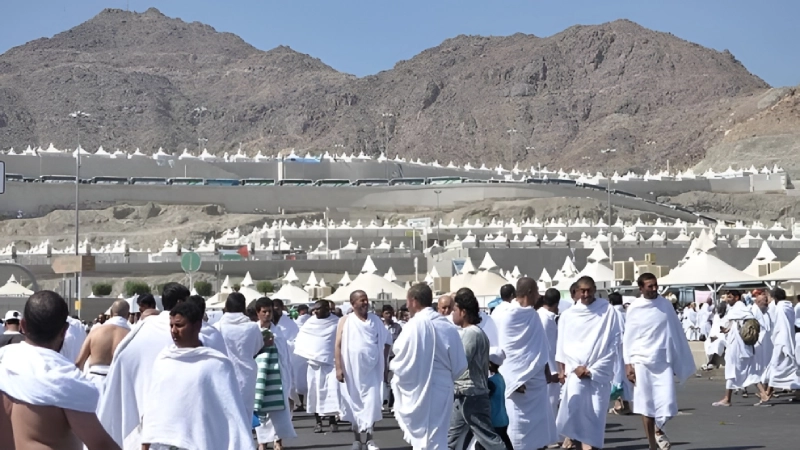
Hajj involves more days, more locations, and much more movement than Umrah. In addition to Tawaf and Sa‘i, pilgrims move between Mina, Arafat, and Muzdalifah, and later return for Ramy at the Jamarat.
Official Saudi references state that Arafat is about 10 km from Mina and 6 km from Muzdalifah, while Muzdalifah is about 5 km from Mina. These are very helpful benchmarks, but the actual walking a pilgrim does still depends on the route and the means of transport. (Saudipedia)
If a pilgrim walks large parts of the sacred-site route, the total can become quite high. When you combine Tawaf, Sa‘i, movement around Mina, and the distances between Arafat, Muzdalifah, and Mina, it is very realistic for Hajj to involve 20 to 40 km or more over several days.
Some pilgrims walk less because they use buses or the holy sites metro, while others walk much more because of the tent location, crowd diversions, or repeated trips to Jamarat. Saudi guidance specifically warns pilgrims to be ready for fatigue, long walking, and heat exposure. (Saudipedia)
Why There Is No Single Exact Number
Many articles give a single exact number for the walking distance to Hajj or Umrah, but that can be misleading. In reality, the total changes because of several factors:
how near or far you are from the Kaaba during Tawaf
whether you perform Tawaf on the ground level or upper floors
whether you walk or use transport between sacred sites
where your Mina camp is located
how crowded the area is at the time
how much extra walking you do for prayer, food, restrooms, and returning to your group
That is why it is more honest to give realistic ranges rather than pretending everyone walks the same distance. (Madain Project)
Spiritual Meaning of Walking in Hajj and Umrah
Walking during Hajj and Umrah is not just physical effort. It is part of the worship. Sa‘i connects the pilgrim to the struggle and trust of Hajar, while Tawaf expresses love, humility, and devotion around the House of Allah.
The movement between the holy sites during Hajj also reminds the believer of obedience, sacrifice, patience, and total reliance on Allah. This is why even difficult steps can become spiritually meaningful. (Saudipedia)
How to Prepare for Walking
Because Hajj and Umrah involve real physical effort, preparation matters. Saudi Hajj advice tells pilgrims to wear comfortable shoes that are good for long walks, bring any medicines they need, stay out of direct sunlight, and drink enough fluids because they can lose a lot of water through sweating. (media1.haj.gov.sa)
A smart pilgrim should start preparing before travel by building stamina with regular walking, using already broken-in footwear, staying hydrated, and planning rest when needed.
This is especially important for older pilgrims and those with health conditions. Saudi health guidance also emphasizes maintaining health to enable the pilgrim to engage in worship fully. (media1.haj.gov.sa)
Conclusion
So, how much do you walk during Hajj and Umrah? For Umrah, the core rituals usually involve a minimum of about 4 km, and often more in practice.
For Hajj, the total is much higher and can easily reach 20 to 40 km or more over several days, depending on your route, camp location, and whether you walk between the holy sites or use transport. (Saudipedia)
The best advice is simple: do not prepare for Hajj or Umrah as if it were only a spiritual trip. It is also a physical journey. If you prepare your body well, the worship becomes easier, safer, and more focused.