
The Spiritual Connection Between Hajj and Tawheed
Hajj is the fifth pillar of Islam, but it is far more than a journey of movement from one place to another. At its heart, Hajj is a living declaration of Tawheed — the oneness of Allah. Scholars explain that one of the Hajj's greatest aims is to direct people to affirm Allah's oneness, to devote worship to Him alone, and to follow His Messenger ﷺ in truth and guidance. (Islam-QA)
From the moment a pilgrim enters ihram until the final rites are completed, every stage of Hajj teaches the believer to leave behind pride, distraction, and attachment to worldly status, and to stand before Allah with humility, obedience, and sincerity. IslamWeb describes Hajj as a great symbol of the actualization of Tawheed in one's worship, direction, and aim. (IslamWeb)
Understanding Tawheed in Islam
Tawheed is the belief that Allah alone is Lord, Creator, Sustainer, and the only One deserving worship. IslamQA explains it as affirming Allah's oneness in Lordship, divinity, and names and attributes. Without Tawheed, no act of worship can truly stand. (Islam-QA)
This is why the connection between Hajj and Tawheed is so deep. Hajj is not merely a symbolic remembrance of past events. It is a direct training in pure worship for Allah alone.
How Does Hajj Relate to Tawheed?
Hajj relates to Tawheed from beginning to end. The pilgrim does not travel for culture, status, or tourism, but to answer Allah's call. IslamQA lists Hajj as a symbol of Tawheed, a reminder of the Hereafter, a symbol of unity, and a training in humility and modest living. (Islam-QA)
This connection appears clearly in the major rituals:
Intention and Ihram
The journey starts with a true desire to please Allah. When you enter ihram, the usual differences in class, style, and comfort are gone. The pilgrim leaves behind worldly display and enters a state centered on obedience and remembrance. IslamWeb notes that Hajj remolds the Muslim through Tawheed and Prophetic guidance. (IslamWeb)
Talbiyah
The Talbiyah is one of the clearest declarations of Tawheed in all of Hajj. IslamOnline explains that its words openly reject all partners for Allah: "You have no partner." It is the slogan of Hajj and a repeated proclamation that praise, blessings, and sovereignty belong to Allah alone. (IslamOnline إسلام أون لاين)
Tawaf
Pilgrims circle the Kaaba, but Muslims do not worship the Kaaba. Rather, the Kaaba is a focal point of obedience to Allah. IslamOnline explains that circling the Kaaba, the symbol of God's oneness, shows that all human activity should have Allah at its center. (IslamOnline إسلام أون لاين)
Arafah
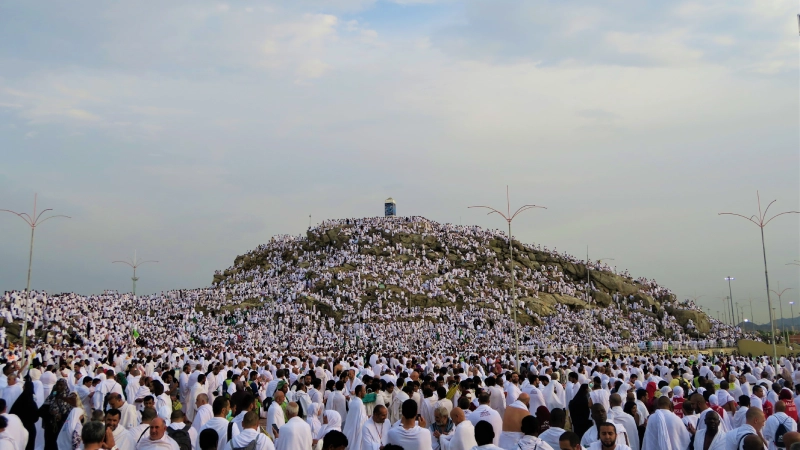
Standing at Arafah is one of the most humbling moments in Hajj. The pilgrim stands with millions of others in need of Allah's mercy, with no worldly distinction that matters. This moment makes us more aware of how great Allah is and how much the servant needs Him.
Sacrifice and Obedience
The sacrifice in Hajj is tied to the legacy of Ibrahim عليه السلام, whose life was built on pure submission to Allah. Hajj revives that same message: obey Allah completely, even when the command is difficult.
Ramy al-Jamarat
Stoning the jamarat symbolizes rejecting evil and renewing obedience to Allah. IslamWeb explicitly describes the rituals of Hajj as symbols of Tawheed, and this ritual is among the clearest examples of rejecting false claims and reaffirming faithfulness to Allah alone. (IslamWeb)
The Spiritual Significance of Hajj
Hajj is a journey of purification, but its purification is rooted in Tawheed. IslamQA notes that Hajj reminds a person of the Hereafter, trains him to accept a modest way of life, and keeps him safe on the Day of Resurrection through Tawheed and the avoidance of shirk. (Islam-QA)
Spiritually, Hajj teaches that:
- Allah alone deserves worship.
- Worldly status has no value before Allah without piety.
- The believer's life should revolve around obedience, not ego.
- The Hereafter is more real and lasting than worldly comfort.
The Spiritual Objectives of Hajj
The spiritual objectives of Hajj align directly with Tawheed. Based on the cited sources, these objectives include:
Strengthening devotion to Allah alone
The greatest objective of Hajj is affirming Allah's oneness and directing all worship to Him alone. (Islam-QA)
Renewing faith and obedience
Hajj teaches the believer to follow revelation and the Sunnah precisely, not personal desire or innovation. IslamWeb highlights the importance of adhering to the Prophet's guidance in Hajj without negligence or exaggeration. (IslamWeb)
Remembering the Hereafter
Hajj reminds the believer of gathering, standing, accountability, and return to Allah. IslamQA explicitly lists remembrance of the Hereafter as one of the purposes of Hajj. (Islam-QA)
Building unity
Hajj gathers Muslims from every part of the world for a set of rites and a single direction of worship. IslamQA names unity as one of the great meanings of Hajj. (Islam-QA)
How Hajj Brings a Person Closer to Allah
Hajj brings a person closer to Allah by combining worship of the heart, body, and money. The pilgrim remembers Allah, calls on Him, obeys His orders, gives up comfort, and goes through rituals that were revealed to him.
IslamOnline describes Hajj as a period of total devotion to the One God, during which Muslims gather to praise Him, seek His forgiveness, and demonstrate unity for His sake alone. (IslamOnline إسلام أون لاين)
This closeness grows through:
- sincere du'a
- repeated remembrance
- patience under difficulty
- detachment from luxury
- reflecting on the life of Ibrahim, Hajar, and Ismail
- following the Sunnah with care
Tawheed in Hajj Rituals
Tawheed is visible in nearly every ritual of Hajj:
- Ihram teaches humility and the leaving behind of worldly distinction. (IslamWeb)
- Talbiyah openly declares that Allah has no partner. (IslamOnline إسلام أون لاين)
- Tawaf symbolizes centering life around Allah. (IslamOnline إسلام أون لاين)
- Sa'i revives trust in Allah through the story of Hajar. This is commonly understood as part of the Abrahamic legacy reflected in Hajj. (IslamOnline إسلام أون لاين)
- Arafah is a scene of surrender, need, and supplication.
- Ramy symbolizes rejection of evil and steadfastness in obedience. (IslamWeb)
Common Misconceptions About Hajj and Tawheed
Muslims worship the Kaaba.
This is false. Muslims worship Allah alone. The Kaaba is the qiblah and a focal point of obedience, not an object of worship. The act of tawaf is worship of Allah, not worship of the building. (IslamOnline إسلام أون لاين)
Hajj is only a cultural or symbolic journey.
This is also false. Hajj is a pillar of Islam and one of the greatest acts of worship. IslamQA states that religious commitment is incomplete without it for the one on whom it is obligatory. (Islam-QA)
The rituals matter more than Tawheed.
The rituals are important, but their greatest meaning lies in what they teach: devotion, obedience, and oneness with Allah. The sources repeatedly emphasize that the greatest objective of Hajj is Tawheed. (Islam-QA)
FAQs on the Spiritual Connection Between Hajj and Tawheed
How does Hajj symbolize the oneness of Allah?
Through the Talbiyah, tawaf, sacrifice, and every act of obedience directed only to Allah. Scholars explicitly describe Hajj as a symbol of Tawheed. (Islam-QA)
What is Hajj's primary spiritual goal?
One of its greatest spiritual goals is to affirm Allah's oneness and devote worship to Him alone. (Islam-QA)
Can Hajj be accepted without Tawheed?
No. Tawheed is the foundation of all accepted worship in Islam. Without it, worship loses its core meaning. (Islam-QA)
Why is the Talbiyah so important in Hajj?
Because it is a repeated declaration that Allah has no partner and that all praise, blessings, and dominion belong to Him alone. (IslamOnline إسلام أون لاين)
How does Hajj spiritually transform a believer?
It increases humility, renews faith, reminds the believer of the Hereafter, and trains the heart in obedience and remembrance of Allah. (Islam-QA)
Conclusion
Hajj is not only a physical pilgrimage. It is a complete school of Tawheed. From the first words of Talbiyah to the final acts of worship, the believer learns to say, with body, heart, and soul, that Allah alone is worthy of worship.
That is why the connection between Hajj and Tawheed is so powerful. Hajj teaches the believer to purify intention, reject shirk, follow revelation, remember the Hereafter, and return home with a renewed commitment to live for Allah alone. (Islam-QA)